Tuesday, June 16, 2020

WE ARE ALL GULLIBLE AT DIFFERENT POINTS


I have recently been enthralled by some of the writing of Rachel Held Evans. She has written some powerful things illuminated by thrilling stories. It may not surprise you that I do not agree with her in some points. But I do recognize her as a fellow believer in Christ.

In honest disclosure, at the beginning of her book Inspired she gave a long list of theologians who had influenced her thinking. I had only heard of one of them. I looked up each one, but I would not dare describe their positions without having read a single book by those I didn't know. It was interesting to me that her list began with some pretty far out Old Testament scholars, and proceeded to some really sound New Testament scholars climaxing with N.T. Wright whose books I have read and love.

I have read two of Rachel Held Evans's books, Looking For Sunday, and Inspired. Especially in Inspired, Rachel (if you will grant me the privilege of calling her by her given name here) tells marvelous stories. She is one of the best storytellers I have ever read. Her portrayal of the gospel as story is accurate and illuminating. Even when I didn't agree with Rachel's point, I was captivated by her stories. But her main arguments for her doubts were close to tantrums that God did things and others believed things of which she didn't approve. I have to admit that I also hold some of her criticisms. And I recognize that she tried to balance criticism with love. But she presents things like authorship of Leviticus or Colossians as well as statements about the dates of certain books of the Bible as unquestioned facts. She admirably makes fun of her doubts, but I would have been happier had she pointed out that some of the arguments for those things don't make sense. But I come from a different perspective. And I recognize that there are people who have been taught those things and believe them to whom she speaks more clearly than I ever could.

C.S. Lewis often dabbled with things in fiction that he would never have said in nonfiction. He was surrounded by people who were not believers. To them he was pointing out that even if things you believe are true, God is still God.

While Rachel undoubtedly adopted theological, moral and social notions that I believe are wrong and harmful, I believe she was also aware that she addressed a culture that has embraced them.

While I admit that I may be wrong in my convictions, I wish she had more doubts about her doubts.

If Rachel were still with us and writing, she might think my convictions are as gullible as I think her doubts are. From an earthly point of view it is a tragedy that she died so young. But she is in the presence of our Lord. I will be there before long. From the perspective of history and eternity we will all stand before God in the blink of an eye. At that point I doubt if we will care about the answers to these issues. Until then, I will seek to broaden my perspective while writing what I am convinced is true. I do wish I could tell stories as thrilling as she did. I pray that God will improve my ability with everything I write.

http://thinkinginthespirit.blogspot.com/
http://theanchorofthesoul.blogspot.com/
http://watchinginprayer.blogspot.com/
http://writingprayerfully.blogspot.com/

Website
http://daveswatch.com/

YouTube
https://goo.gl/PyzU

Amazon Author's Page
https://www.amazon.com/David-Young/e/B008C7VLAQ/ref=dp_byline_cont_ebooks_1

Sunday, April 19, 2020

DEVELOPING THE SOUL OF A WRITER

DEVELOPING THE SOUL OF A WRITER


While this quarantine is difficult for people all over the world, it is not quite as hard on writers. I do not simply mean that people need our reading material to fill the time. Writers need solitude to write. While many of us have had to learn to write in the midst of the hubbub, it always helps to be alone. This doesn't mean that we are not going stir crazy like everyone else. But this is an opportunity of which we must take advantage. Since most writers support ourselves with day jobs, you may find that you have more time to write than ever before. That is true even if you're having trouble paying the rent.

This is also an important time for a Christian to develop the character and the depth of your soul as a writer. I actually began this nearly a year before the pandemic broke out. The quarantine is a good opportunity to continue what I have begun. I am memorizing the Bible like never before. I do not memorize to have important things to quote in my writing or to impress my friends at church. I memorize Scripture so that God will plant His mind, His insights, His character in me. The mind of Christ is essential for growing as a writer.

I am going through the New Testament taking an entire week with each chapter. I read the whole chapter every day for a week. Each day I memorize a portion of that chapter, usually getting the entire chapter memorized in a week. I start by reading over the first verse of the chapter until I can say it. Next, I read over the second verse until I can say it. Then I go back and read both verses together and go on to the third verse. If I am working on 1 John, two or maybe three verses will be all I need to memorize each day. If I am trying to memorize a chapter, say early in Luke, with over 60 verses, I need to memorize more each day, and I often take a little more than a week to memorize it. After I have memorized a chapter, I review it every day for two weeks. This way I am working on three chapters of Scripture all the time. To review the passages, I use the same process as my memorization. I read the first verse in the passage over until I can say it. Usually the second day I have to memorize it all over again. I go on from there to the next and then the next. I often stumble over verses I have been reviewing for weeks. If I think I am in some kind of competition, I will be discouraged. But this is between me and God, and I trust Him to be working in my life as I spend the time with Him.

I do not have a photographic memory. I could not begin to quote verses that I memorized 6 months ago without reviewing them again. But in the process of memorizing and especially reviewing, God's Spirit works on my heart. He uses His word to plant Himself in me. Although I am writing something that tends to consume my time and thoughts, I am convinced that Scripture memory is my most crucial task in these days.

http://thinkinginthespirit.blogspot.com/
http://theanchorofthesoul.blogspot.com/
http://watchinginprayer.blogspot.com/
http://writingprayerfully.blogspot.com/

Website
http://daveswatch.com/

YouTube
https://goo.gl/PyzU

Amazon Author's Page
https://www.amazon.com/David-Young/e/B008C7VLAQ/ref=dp_byline_cont_ebooks_1
Tuesday, January 28, 2020

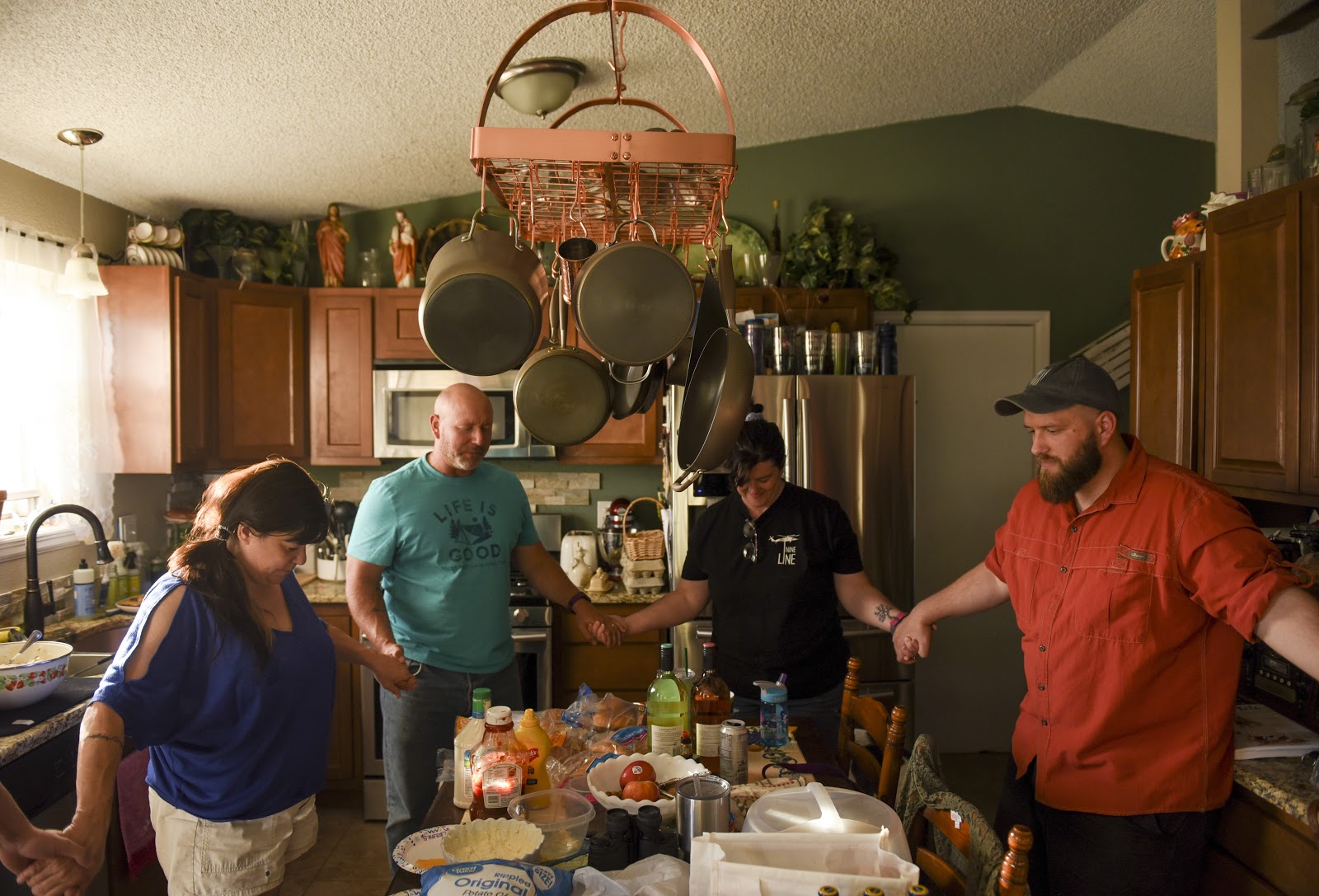
SAYING A BLESSING


I remember my father saying the blessing at every meal as I was growing up. That memory continues to bless me everyday of my life. It was not unlike the blessing of Jesus over the loaves and fish.

"And taking the five loaves and the two fish, he looked up to heaven and said a blessing over them. Then he broke the loaves and gave them to the disciples to set before the crowd."
Luke 9:16

This is a beautiful picture that is worth considering separate from the rest of the event of which it is a crucial part. The One who created all things made the bread and fish nourishing. He had already put His blessing on it. But it would only have fed one boy. Jesus looked toward His Heavenly Father, and by His power He blessed the meal so it would feed a multitude. Luke said there were about five thousand men there. How many women and children might have been there? That could easily have been a multitude of twenty or thirty thousand souls.

I would like to do something like that with my writing. As I write, I pray with all my heart that God will put more of His grace in my words than I know to write. And I also pray for a blessing like Jesus prayed for, that God will multiply it to touch the lives of multitudes of people.

http://thinkinginthespirit.blogspot.com/
http://theanchorofthesoul.blogspot.com/
http://watchinginprayer.blogspot.com/
http://writingprayerfully.blogspot.com/

Website
http://daveswatch.com/

YouTube
https://goo.gl/PyzU

Amazon Author's Page
https://www.amazon.com/David-Young/e/B008C7VLAQ/ref=dp_byline_cont_ebooks_1
Tuesday, October 15, 2019

New Book, TAKE ME TO THE GARDEN


David and his sister-in-law, Jonna Padgett, have collaborated on a book of poetry. It is available on Amazon.com

Take Me To The GardenTake Me To The Garden

by Jonna Padgett and David Young

Here is one of the poems included in the book.


LIGHTNING ON THE MOUNTAIN TOP


Standing on the thundering alp,

Drenched in heaven's driving tears

With bending knees and tingling scalp

My glasses whining in my ears;


He's drawn me to this holy place.

Shying from His glorious essence,

I'm wincing from His gleaming face,

Trembling in His holy presence.


Streamers reaching from my heart

Do not draw the heavens there.

Though I do my trembling part


Sunday, September 1, 2019

DID SOMEONE THROW THE DART? on answering questions in print


Answering questions before a live audience can be tricky business. I wonder if it is easier or sometimes better in print. Last night I listened to a recording of Eric Metaxis speaking on his book MIRACLES, at Rutgers University. The primary miracles Eric told about in his talk, outside of his own conversion, were on the fine tuning of the universe. Scientists say the chances of all the parameters of the universe coming about by chance approach 0%, and go beyond it. Eric condensed that part of his book into The Wallstreet Journal article, Science Increasingly Makes The Case for God. (https://www.wsj.com/articles/eric-metaxas-science-increasingly-makes-the-case-for-god-1419544568) That article, by the way, had more than 600,000 shares and 10,000 comments on line.

After his talk, Eric took questions. And I want to respond to one of the questions raised. The questioner asked about slim chance of the fine tuning of the cosmos. "If you had a dart board and you divided it into a trillion squares, and you threw a dart that hit one of the one in a trillion squares, it doesn't show skill or intention, if you didn't call it in advance. How is that different from the fine tuning of the universe?"

Okay, I would like to to try to answer this question. Let's propose the trial of the millenia. Let me change the details a little. Suppose investigators come into a room and find a mouse with a dart pinning it to the floor. The question arises, "Who threw the dart?" You and I are called to be on the jury. During the trial Attorney #1 claims someone with incredible skill threw the dart. Attorney #2 says this could have happened without anyone throwing the dart. He brings a witness who says the mouse may have always been there with a dart in it.

Attorney #1 brings a witness who shows by the blood on the floor, the mouse was alive when hit by the dart.

Attorney # 2 says the mouse did not have to be a moving target.

Attorney #1 brings a witness who says the odds are exceedingly great that the mouse was moving when the dart hit him. And he goes on to ask how a dart came to be in the room.

Attorney # 2 says it is possible that a million years ago there could have been a meteor shower. One of the meteorites could have had a metal shard in it. And as it fell it struck a tree. Eons passed, and all of the tree but the small part with the metal embedded in it was worn away by the weather and elements.

Attorney # 1 claims the dart could not have moved with such precision without being thrown.

The other says a freak wind could have swept through the house picking up the dart and flinging it into the mouse.

At some point you might want to say, I wonder if there is not some reason other than the arguments presented that make the sides pose what they are presenting.

And if we want to believe arguments for or against the reality or intervention of God in the universe, what is our motivation? The man seemed to assume that God did not say in advance what the parameters of cosmology would be. How would he have known that? He could not have been there to hear. You could not have heard either. But we might ask God to speak to us now. Wouldn't that settle the issue for you?

Now, whether you think this is a good answer or not, I would like to present it to people who struggle with the issue. And writing seems to be a good forum for this. When I heard this question, I could not think of a good answer. I thought the question oversimplified the issue of the fine tuning of the universe. And I knew at Rutgers, like many universities, there would be great cultural pressure not to believe in God. But in writing I had time to formulate a situational apologetic.

But I don't have readers who would raise the question. I write in a symbolic echo chamber. I primarily read and write with those who basically agree with me. I do not have a good solution for this. I wonder if some of you have experience, or even theories about how to do this, I would appreciate your responses.

http://watchinginprayer.blogspot.com/
http://thinkinginthespirit.blogspot.com/
http://writingprayerfully.blogspot.com/
http://theanchorofthesoul.blogspot.com/

Website
http://daveswatch.com/

YouTube
https://goo.gl/PyzU

Tuesday, July 23, 2019

FOOTNOTES

I just wrote one of my other blogs on Footnotes in the Bible. And it made me think of footnotes in general. Do you use footnotes when you write? I like footnotes. But before I say anything more, need to admit that footnotes are not popular in these days for a number of reasons. Maybe foremost among those reasons is that editors don't like them. That may not be a strong enough statement. Many editors hate them. And what writer wants to offend an editor? Magazines don't use them at all. If you are writing for a magazine, don't bother. Or rather, find a way to say what you need to without using a footnote. Having said all that, I still like to use them for several reasons.

First, I use them to maintain a little subtlety. I occasionally think of something to say that requires a certain amount of wit or background knowledge to understand. As a reader, I like to figure those things out. Years ago I wrote a magazine article entitled, Filling The Unforgiving Minute. This comes from Kipling's poem, IF. The magazine needed me to tell readers where this came from in the text. But I am now including that article in a book I am writing on hope. Here I would like to give readers the opportunity to remember where the line comes from. But I also want to write a note to those who don't remember.

We also need footnotes to record Sources for what we write. This is crucial for technical writing, or for arguments that make a point. I once heard a joke on preachers who rattle off a lot of statistics in their sermons.

"87% of all quoted statistics are made up on the spot."

If someone wants to quote me in a speech or in writing, I want them to know where I got what I have written.

And footnotes are great for Clarification. In a note I can say, "I meant this." or "I didn't mean that."

I also like to make side Comments in some of what I write. You might call these wisecracks. In my book, JOY, I quoted something from The Magician's Nephew, by C.S.Lewis. I said in the text that this book was the sixth in the Narnia Chronicles and a prequel to the other books. But in a footnote I commented on a publication of the Narnia books that listed The Magician's Nephew as the first book in the series because it would have been first chronologically. I said those who listed the book so were "Philistines."

For whatever reason, footnotes are a means of adding depth to what we write. And even though most readers are in too much of a hurry to bother with them, there is pleasure in such notes for those who take the trouble to read them.

http://thinkinginthespirit.blogspot.com/
http://theanchorofthesoul.blogspot.com/
http://watchinginprayer.blogspot.com/
http://writingprayerfully.blogspot.com/

Website
http://daveswatch.com/

YouTube
https://goo.gl/PyzU